

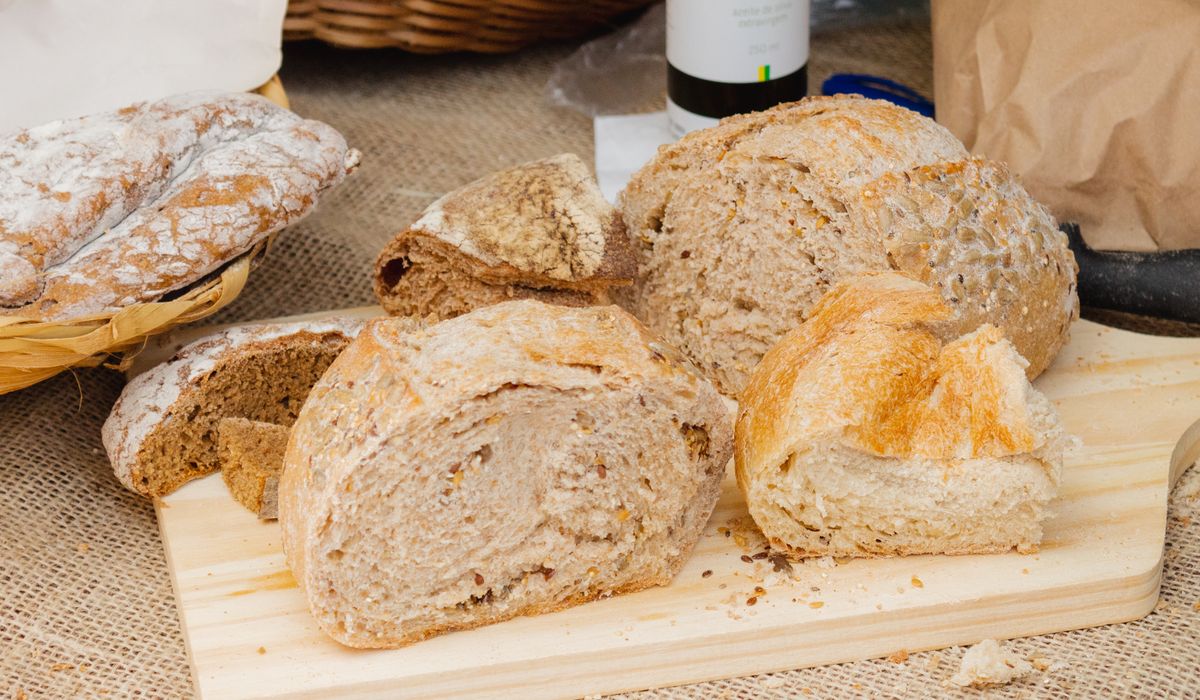
Why wholegrain flour demands a different touch
Wholegrain flour is not simply white flour with bran added back. It contains the entire kernel: the starchy endosperm, the nutrient-rich germ, and the fibrous bran. That bran is the troublemaker. Its sharp edges physically cut through gluten strands as you knead, and it absorbs water far more slowly than the endosperm. The germ brings flavour and oils, but those oils can weaken gluten if the flour is old. The result? A dough that can feel stiff one minute and slack the next, and a loaf that bakes up dense if you treat it like a white flour dough.
British heritage wheats — think older landraces and population varieties grown on low-input farms — often have a different gluten profile from modern high-protein bread wheats. They may be lower in gluten strength but richer in flavour. When milled whole, they need patience, not force.
Start with more water and a long rest
Wholegrain flour can easily absorb 10–15% more water than white flour. A dough that looks too wet at first may be perfect after half an hour. Aim for around 75–85% hydration for a 100% wholemeal loaf, though you may need to adjust for your particular flour. Begin by mixing flour and water only — no salt, no yeast — and let it sit for 30 to 60 minutes. This is the autolyse. During this rest, the bran softens, enzymes begin breaking down starches, and gluten starts to form on its own. You will feel the dough become smoother and more extensible without any kneading.
Add salt and levain after the autolyse. If your dough still feels tight, add a little extra water — a technique called bassinage — by squeezing it in with wet hands.
Knead gently, then rely on folds
Forget vigorous kneading. With wholegrain, aggressive handling tears the bran through the gluten network and can leave you with a sticky, unworkable mass. Instead, use stretch and folds during bulk fermentation. After mixing, wait 30 minutes, then perform a set of folds: lift one side of the dough, stretch it upwards, and fold it over the centre. Rotate the bowl and repeat four times. Do three or four sets, spaced 30 minutes apart. Each set builds strength without shredding the bran.
You can also use a gentle slap and fold on the counter, but keep the motion light. The dough should feel soft, slightly tacky, and increasingly billowy. If it resists, cover it and wait 15 minutes — time is a better tool than muscle.
Shape with tension, not force
When bulk fermentation is done — the dough should be puffy, with visible bubbles and a slightly domed top — turn it out gently. Avoid punching it down. For a round boule, shape by folding the dough onto itself, then use your cupped hands to drag it across an unfloured surface to create tension. For a batard, fold the sides in and roll gently. The goal is a tight outer skin without degassing the interior. Place it seam-side up in a floured banneton or a bowl lined with a tea towel.
For the final proof, a cold retard in the fridge (8–16 hours) develops flavour and makes the dough easier to score. Bake in a preheated Dutch oven or on a hot stone with steam for the first 15 minutes. Wholegrain loaves benefit from a slightly lower oven temperature — around 200°C fan — to prevent the crust burning before the centre cooks.
British wheat heritage and the sustainable loaf
Many British bakers are rediscovering heritage wheats: older varieties like Red Lammas, Hen Gymro, and population wheats such as YQ. These are often grown by farmers using organic or low-input methods, because they tolerate poorer soils and need less nitrogen fertiliser. Stone-milling retains the germ and bran, so the flour is alive with oils and nutrients. But that same wholesomeness makes gluten development trickier.
When you bake with wholegrain heritage flour, you are supporting a more sustainable grain economy. Diverse rotations, fewer chemicals, and local milling all reduce the carbon footprint of your loaf. And the flavour? Nutty, sweet, and complex — nothing like commodity wholemeal.
- Choose fresh flour: wholemeal goes rancid quickly. Buy from a local mill or farmer and use within three months.
- Blend if needed: 20–30% white flour can help structure while keeping most of the wholegrain character.
- Keep notes: every harvest differs. Record water, rest times, and folding to learn your flour’s habits.





John Doe
14 January, 2022Having no content in post should have adverse..
Chauffina Carr
10 April, 2022We use these tests all time! Killer stuff!
Jim Séchen
16 July, 2022Thanks for all the comments, everyone!